
Daoyuan Jin, Daniel Petti, Xuehai Zhou, Peter Ngimbwa, Glen Rains | 05 November 2026
https://www.nature.com/articles/s44264-026-00199-w
Abstract
Artificial intelligence-based agents are emerging as a transformative paradigm for agriculture, enabling autonomous perception, reasoning, decision-making, and coordinated action across complex data and operational environments. These systems could improve productivity, resilience, resource efficiency, and food security, while raising challenges related to robustness, interoperability, data governance, trust, equity, and regulation. This Review examines the rise of these systems in agriculture and outlines research priorities for their development and deployment.
Explore related subjects
Discover the latest articles and news in related subjects.
- Complex networks
- Environmental social sciences
- Information systems and information technology
- Science, technology and society
Introduction
An intelligent agent is a self-contained system that perceives its environment and autonomously selects actions to achieve a goal1. Agents have been a foundational concept in artificial intelligence (AI) for decades, with philosophical roots in Daniel Dennett’s notion of the intentional stance: treating a system as if it had beliefs and desires can be a useful explanatory framework even absent conscious deliberation2.
Recently, the term agentic AI has gained popularity to describe systems in which multiple specialized agents coordinate, often through shared memory, tools, and communication protocols, to pursue a higher-level objective. While the underlying ideas connect to early work on multi-agent systems3, recent advances in large language models (LLMs) and multimodal foundation models have made it possible to build agents that are far more flexible, adaptive, and tool-capable than earlier approaches.
In this framing, AI agents refer to the individual decision-making entities, whereas agentic AI refers to the use of agentic workflows in which AI agents autonomously make decisions, take actions and coordinate tasks with minimal human intervention3. A key distinction from many earlier AI paradigms is that an agentic system is typically not provided all task-relevant information upfront; instead, it is given high-level instructions and is expected to iteratively plan, query or gather information, and take actions within an environment. In this sense, agentic AI extends reasoning-capable LLMs by coupling them to structured planning, environment interaction, and tool use for complex, multi-step problem solving.
Over the past few years, LLMs have begun to appear in agricultural contexts, with most early work focused on building agriculture-specific chatbots and foundation models4,5,6,7. The potential of LLMs for extracting information from unstructured text8 has also led to LLM-based approaches for monitoring injuries in the agricultural sector9. Crucially, however, LLMs used as a decision support tool have been less popular in this context until recently, with one exemplary approach focused on automating crop management decisions10. We suspect the slow adoption of LLMs as part of practical decision support systems in agriculture may be due to the models’ limited ability to reason their way through complex tasks. If so, agentic AI provides a possible path towards mitigating this.
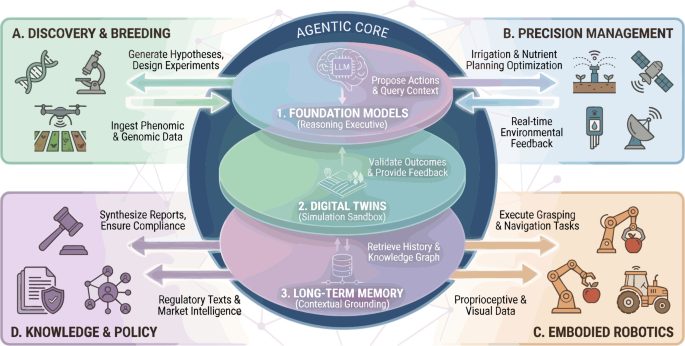
Agentic AI has the potential to transform agriculture-centered systems in areas such as phenomics and breeding, informed decision support for crop production management, agricultural robotics and regulatory policies. Autonomous scientific discovery frameworks couple large language models, tools, and agentic workflows to co-design experiments, analyze high-throughput phenotyping data, and iteratively refine hypotheses, effectively acting as collaborative research partners for plant breeders and crop scientists. Additionally, informed decision support agents can integrate crop models, sensor networks, and external knowledge bases to help farmers plan planting, irrigation, pest and weed management, and harvest operations, while reinforcement-learning-driven agents explore management strategies using realistic digital twins. Further, when embodied in fleets of unmanned aerial vehicles (UAVs) and ground vehicles (UGVs) operating in the field, agentic AI can close the loop from perception to action, enabling adaptive scouting, targeted interventions, and more dexterous manipulation for tasks such as selective harvesting and in-field sampling. Finally, regulatory and policy agents can ingest large volumes of heterogeneous data, such as injury reports, remote sensing products, and stakeholder surveys, to construct structured evidence bases that inform safety regulations and investment priorities. Agentic AI in agriculture has the potential to help optimize efficiency, safety, productivity, and sustainability in modern farms.
Although agriculture is deeply embedded within broader food systems, this review focuses primarily on agricultural research and production, including phenomics and breeding, crop management, agricultural robotics, and agricultural policy. Downstream food-system applications, including food processing, food safety, personalized nutrition, supply-chain optimization, and food-system governance, represent important complementary directions and have recently been reviewed in the context of agentic artificial intelligence in food science11. Therefore, we treat these downstream food-system applications as adjacent to, but outside the main scope of, the present review.
The goal of this review is to introduce the concept and key technical components of agentic AI, propose potential application domains, and present case studies in agriculture. We also identify technical and social challenges and explore potential future research directions for sustainable agricultural research and production.
Taxonomy and components of agentic AI
From agent to intelligent agent to multi-agent system
An agent is typically defined as an entity that can act autonomously within a specific environment to achieve certain design objectives12. The way an agent is structured often depends on environmental characteristics for interaction. Compared to a basic agent, an intelligent agent focuses more on flexible autonomous behavior. This flexibility is usually described in terms of three qualities: the ability to respond to environmental changes (reactivity), the ability to take initiative to achieve objectives (proactivity), and the ability to communicate or cooperate with other agents or humans (social ability). This has been widely used in software engineering3. In the AI context, AI researchers often define an intelligent agent as a software entity that demonstrates all three of these behaviors effectively in dynamic environments.
While the concept of an intelligent agent typically refers to a single system, the idea naturally extends to multi-agent systems. These systems comprise several intelligent agents that not only operate independently but also interact and coordinate with one another. Individual agents in a multi-agent system are usually specialized for specific categories of tasks, such as coding, and they must collaborate to accomplish a given task. Splitting a complex job among multiple agents in this way brings all the benefits of modular design, including simpler, easier-to-design agents that are more reusable across different jobs. However, inter-agent communication now poses a challenge, making reliability harder to ensure.
This progression from agent to intelligent agent and then to multi-agent system shows that an agent-centered perspective offers a clearer framework for developing the essential components of intelligent systems. In contrast, discussions about AI often use broader, more ambiguous terms. For example, some researchers have suggested that an AI agent focuses on specific tasks, whereas agentic AI is oriented toward broader goals13. However, the difference between a task and a goal is often unclear and can vary significantly depending on the problem context. In many cases, how these terms are understood is also shaped by the cultural and socioeconomic backgrounds of the system designers.
Because of this ambiguity, applied AI researchers may find it difficult to make meaningful progress when they rely too heavily on loosely defined terms. Before the recent emergence of LLM-based agents, the concept of an agent was particularly common in reinforcement learning and robotics, where an agent typically observes the environment’s state, selects actions according to a policy or decision-making mechanism, and receives feedback from the resulting interaction. In robotics, this interaction occurs through physical sensors and actuators. This traditional interpretation is particularly relevant to agriculture and other industrial sectors, where useful agent systems must often produce physical effects in the real world rather than operate solely within digital environments, in which early “agentic” systems have recently achieved success. In fact, it has been argued that the term “agentic” is mere marketing fluff masquerading as technical jargon, and, in common usage, denotes little more than an intelligent agent with an LLM under the hood3. As such, the research community might do better to continue using the older “intelligent agent” and “multi-agent systems” terminology to minimize confusion and avoid obscuring the wealth of prior work in this field. For now, seeing as the rest of the world (most conspicuously our partners in industry) seems to favor the “agentic” terminology, we propose that both can reasonably be used interchangeably. Though we admit that this might not be ideal, it still seems preferable to appointing ourselves the arbiters of language.
Core components of agentic AI
An intelligent agent typically consists of four core components that operate in a continuous loop: perception, reasoning and decision-making, action, and learning and adaptation (Fig. 1).
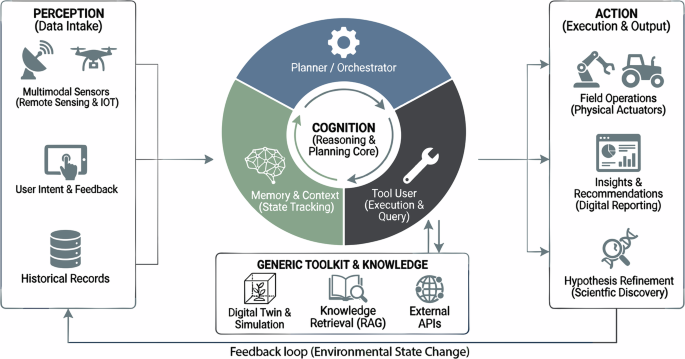
Perception is responsible for collecting information from the environment in which the agent operates, whether it is physical, digital, or a combination of both. The choice of sensing modalities depends on the agent’s design objectives. These may include visual, auditory, olfactory, haptic, thermal, or other sensors, which help provide a comprehensive understanding of both the environment and the agent’s internal state. Action refers to the agent’s ability to interact with its environment. In physical environments, this may involve using actuators or robots. In digital environments, actions can include interactions via operating system interfaces, such as APIs that enable integration with other software platforms. Both the perception and action components may involve hardware and software, and their design is often closely tied to the intended application of the intelligent agent. Embodied agents, for instance, have access to a specific collection of sensors (such as cameras, LiDARs, and proprioception) and low-level software to decipher sensor data that LLMs can process, such as image captioning models14 or object detectors15. They can subsequently act on the environment using a variety of actuators, including mobile bases, robotic arms, and custom end-effectors. All of these components can be tailored to the specific tasks that a robotic system is designed to accomplish. Reasoning and decision-making, as well as learning and adaptation, are primarily software-based and are typically implemented with LLMs in modern agentic AI frameworks. However, LLMs might have access to external components such as databases or memories that enhance these functionalities and could even enable some form of learning.
The introduction of LLMs makes it possible to create agents that are far more adaptable than the multi-layer approaches, such as Touring Machines16 or InteRRaP17, which dominated in the 90s and early 2000s. The modern LLMs enhance the reasoning and learning capabilities of agent systems, making them more autonomous, reactive, and proactive, especially with techniques such as retrieval-augmented generation (RAG)18 and the integration of memory systems. RAG allows a model to incorporate context from external data sources when generating outputs, in contrast to vanilla LLMs, which are confined to the knowledge (or data) they learned during training. External memory allows an agent to store and later retrieve vital information, ensuring knowledge is retained over the long term rather than lost due to the model’s limited context window. These advancements are critical for achieving continuous learning and meaningful adaptation to changing conditions. While an intelligent agent based on general-purpose LLMs (GPLLMs) can be designed to perform a wide range of tasks, its effectiveness is often limited when applied to highly specialized domains. For example, an agent based on GPLLMs may not function effectively as an agricultural engineer in data analysis or agricultural robot design because it lacks domain-specific knowledge and context. This limitation can lead to hallucinated outputs. To address this challenge, researchers have focused on specializing agents for particular domains5,10. These efforts have shown that domain-specific agents can perform better in solving real-world problems, even though GPLLMs can excel at niche tasks when prompted carefully and imbued with the proper knowledge9,19. In particular, chain-of-thought prompting20 is commonly used to enhance the reasoning abilities of GPLLMs.
A core aspect of most agentic systems is agents’ ability to leverage external tools. Tools allow an agent to proactively acquire external knowledge, leverage capabilities (e.g., memorization and rote math) that LLMs don’t naturally possess, and interact with the environment (e.g., via APIs). Tool use has become relatively standardized with the introduction of the model context protocol (MCP)21, which specifies a standard method for LLMs to exchange information with external tools. MCP enables a standardized protocol that decouples tool development from specific LLMs, dynamic tool discovery and schema negotiation, and asynchronous communication between tools and the host agent.
Another important aspect of an agentic system is the ability to coordinate interaction among agents in a multi-agent system using a standardized communication mechanism, such as the agent-to-agent (A2A) protocol22. This capability for inter-agent communication enables agents with diverse expertise to collaborate securely and in real time to tackle complex problems that no single agent could solve independently. Given this potential, developing effective communication and consensus strategies for multi-agent systems has become a significant area of interest in both the agentic system and AI research communities.
From an agent-centric perspective, the most significant contributions of recent AI developments lie in the reasoning and learning modules of agent systems20,23. These advances have greatly improved the problem-solving abilities of agents. However, developing and training new foundation models requires substantial resources, often beyond the reach of individual research groups or academic institutions. In contrast, designing agent architectures that leverage existing foundation models through mechanisms such as RAG, memory systems, and modular task structures offers a more feasible and impactful approach for many applied researchers, especially for agriculture and food, which are the least digitalized among all industry sectors.
Emerging work and pilot case studies in agriculture systems
Literature searching criteria and overview
To systematically identify relevant works on agentic AI in agriculture and closely related food-system contexts, we conducted a literature search using the Web of Science Core Collection. The search query was constructed as:
agent AND (agriculture OR food) AND Large Language Model
The temporal scope was set from November 30, 2022 to November 30, 2025, with the start date corresponding to the public release of ChatGPT24, which marked a pivotal moment for language-based agent applications. This 3-year window captures the emergence and rapid development of LLM-powered agentic systems in agricultural contexts.
The initial search yielded 19 results. We then applied manual screening to exclude works primarily focused on health, climate modeling, or general systems engineering, as well as one review article, resulting in ten papers from indexed venues. To ensure comprehensive coverage of this fast-moving field, we supplemented the corpus with several high-relevance works from arXiv that demonstrated significant methodological contributions or influence within the research community. The final review corpus comprises 19 works, summarized in Table 1. The corpus includes only published or publicly available works with citable manuscripts; unpublished conceptual frameworks, such as PAAS, were not included.
Table 1 Existing work in agentic AI systems for agriculture
We categorize these works into three types based on their architectural complexity and functional scope: Single Agent (Chat), Single Agent (Action), and Agent System. Chat agents primarily provide conversational interfaces for knowledge retrieval and question answering, representing functionality that is closest to that of general-purpose language models. Action agents extend beyond conversation to execute specific agricultural tasks such as disease diagnosis, crop management decisions, or data processing. Agent Systems comprise multiple coordinated agents that work together to execute complex workflows in agricultural applications.
Among Chat agents, early works such as AgriBERT6 and ChatAgri4 explored the adaptation of language models for agricultural text processing, focusing on domain-specific knowledge infusion and cross-linguistic capabilities. Subsequent efforts, including PLLaMa5 and PlantGPT25 developed open-source models tailored specifically for plant science, while AgAsk26 demonstrated retrieval-augmented approaches for answering farmer questions from scientific literature.
Action agents exhibit a stronger emphasis on task execution and decision support. ChatLeafDisease19 and Anand et al.27 apply chain-of-thought prompting and embedding-based retrieval for disease diagnosis, while Wu et al.10 position language models as expert systems for crop management. Other works address diverse application domains, including agricultural injury surveillance9, auction mechanisms28, food security assessment29, and farm recordkeeping30.
Agent Systems represent the most architecturally complex category, featuring multi-agent coordination for sophisticated workflows. PhenoAssistant31 and Aleks32 deploy conversational multi-agent frameworks for plant phenotyping and autonomous scientific discovery, respectively. Several works integrate LLM-based agents with complementary technologies: Khanna et al.33 and Benzinho et al.34 combine generative AI with blockchain for supply chain traceability, while InsNet-CRAFTY35 couples institutional network dynamics with land use simulation.
Several trends emerge from this corpus. First, compared to domains such as software engineering, healthcare, and scientific research, where LLM-based agents have proliferated rapidly, agricultural applications remain at an early stage, as evidenced by the limited number of works identified in our search. Nevertheless, the field has progressed from basic chat interfaces toward action-oriented and multi-agent architectures, reflecting growing ambitions for autonomous agricultural decision-making. Second, there is a notable concentration in plant science applications, particularly disease diagnosis and phenotyping, likely due to the availability of structured datasets and clear evaluation metrics in these domains. Third, recent works increasingly emphasize integration with external systems such as blockchain, simulation platforms, and robotic interfaces, suggesting a trajectory toward embodied and interconnected agricultural AI systems.
To provide deeper insight into the design and capabilities of emerging agentic AI systems in agriculture, we present two published pilot studies that exemplify the multi-agent paradigm, PhenoAssistant31 and Aleks32, together with the Peanut Agentic AI System (PAAS), an unpublished conceptual framework proposed by members of the author team. The three cases represent distinct architectural approaches to multi-agent coordination in agricultural contexts. PhenoAssistant demonstrates conversational orchestration for plant phenotyping workflows, Aleks showcases autonomous scientific discovery through data-driven agent collaboration, and PAAS illustrates a proposed domain-specific agent architecture for peanut production management. Together, these cases illuminate both the current state of the art and potential directions for agentic AI systems in agriculture.
PhenoAssistant
PhenoAssistant31 is an open-source conversational multi-agent AI system designed to democratize plant phenotyping analysis for researchers with limited computational expertise (Fig. 2). The system architecture comprises a manager agent powered by an LLM like GPT-4o and a specialized toolkit containing modules for phenotype extraction, analysis, and visualization. The workflow follows a four-stage process: plan generation, tool selection, tool execution, and result summarization. Users interact with the system through natural-language instructions that specify either tasks (e.g., “analyze plant growth”) or desired data outputs (e.g., “extract leaf area measurements”). For each user instruction, the manager agent decomposes the request into a step-by-step execution plan, identifies appropriate tools from the toolkit, executes them, and synthesizes the results into structured outputs such as phenotype tables, growth curves, or analytical insights.
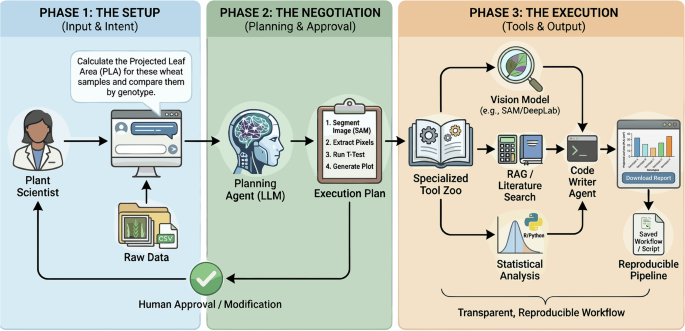
Evaluation across diverse phenotyping tasks demonstrated an average tool-selection score of 4.55 out of 5 across 20 tasks, 100% accuracy in two vision-model selection evaluations, and 85% accuracy across 20 phenotype data-analysis tasks. The remaining errors in data analysis occurred during tasks requiring fine-grained interpretation of plots. PhenoAssistant automates phenotypic analysis workflows while allowing users to optionally intervene and refine intermediate steps when needed. While the system automates the execution of computational pipelines and handles technical complexity, higher-level scientific reasoning, such as experimental design, hypothesis formulation, and interpretation of biological significance, remains under human guidance. The toolkit provides predefined functional components and can be extended with additional vision models and tools. This architecture exemplifies an interactive agentic approach in which AI automates and coordinates computational workflows while retaining the option for user oversight.
Aleks
Aleks32, developed by members of the author team, introduces an architecture tailored for autonomous scientific discovery in plant sciences (Fig. 3). Designed as a three-agent system comprising a Domain Scientist, Data Analyst, and Machine Learning Engineer, Aleks integrates domain-grounded reasoning, data analysis, and predictive modeling within an iterative workflow. The agents interact through a shared reflective memory that records intermediate results and errors, supporting iterative refinement and learning from failed attempts.
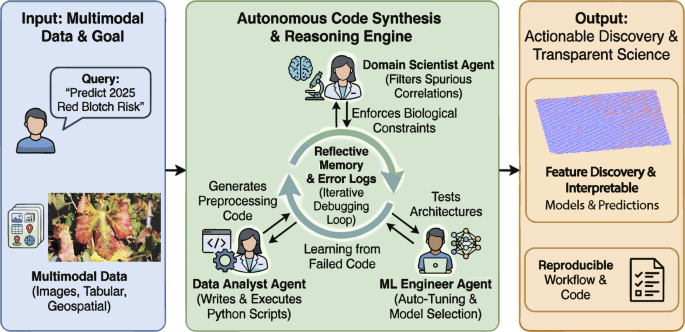
In a case study on grapevine red blotch disease (GRBD), Aleks received only a short natural-language prompt (“Predict red-vine disease in 2023 or 2024”) and raw vineyard data. It autonomously formulated hypotheses, engineered biologically meaningful features, trained and evaluated predictive models, and generated interpretable predictions and reproducible analysis code. Across five independent runs for each prediction year, the classification models for the 2023 task achieved accuracy and weighted F1 scores of up to 0.95, while the regression models for the 2024 task achieved R2 values of up to 0.82. Across these runs, Aleks consistently identified key epidemiological and canopy traits, including historical disease incidence, geospatial information, canopy dimensions, and vegetation indices.
Compared with PhenoAssistant and Virtual Lab, Aleks places greater emphasis on autonomous, iterative scientific reasoning and model development, progressing from problem formulation to interpretable predictions and reproducible computational workflows. By embedding domain-grounded reasoning within an autonomous multi-agent structure, Aleks demonstrates how AI can act not merely as an analytical tool but as a scientific collaborator, completing complex research tasks within hours and providing a scalable foundation for future development.
Peanut Agentic AI System (PAAS)
The Peanut Agentic AI System (PAAS), an unpublished conceptual framework proposed by members of the author team, is designed to support in-season predictions and actionable recommendations for peanut farming (Fig. 4). PAAS leverages Python’s extensive ecosystem of machine learning, data processing, and Agentic AI development libraries. Its architecture follows a modular, hierarchical design centered on an orchestrator agent called OrchestratorAgenticAI. The OrchestratorAgenticAI interprets the request, identifies the required subtasks, and selects the appropriate specialized agent based on the capabilities described in that agent’s Agent Card. It creates a task record in a Task and Evidence Ledger, delegates the task, monitors its status, and collects the returned result. The ledger retains the task identifier, assigned agent, processing status, data sources, timestamps, and generated output so recommendations can be traced and audited. If a request requires more than one area of expertise, the orchestrator can obtain results from multiple specialized agents, identify inconsistent or incomplete outputs, and combine the results into a response for the user.
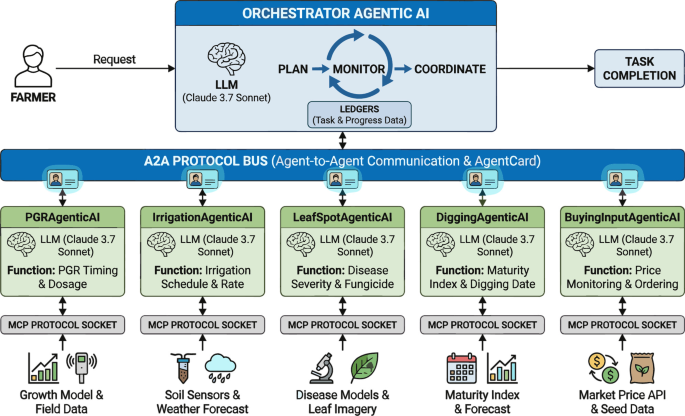
PAAS contains five specialized agents. PGRAgenticAI combines crop-growth predictions and field observations to assess excessive vine growth and generate a field-specific recommendation concerning plant growth regulator timing and dosage. IrrigationAgenticAI uses soil-moisture observations, weather forecasts, crop information, and an irrigation model to estimate whether irrigation is needed and, if so, when and how much. LeafSpotAgenticAI processes UAV imagery to estimate early- or late-leaf-spot severity and propose a treatment option and quantity, subject to product-label requirements and expert review. DiggingAgenticAI combines pot-maturity observations with short-term weather information to estimate an appropriate digging window. BuyingInputAgenticAI uses market price information, input requirements, and available agrochemical data to provide price comparisons and procurement timing recommendations. PAAS uses specialized agents to separate domain-specific responsibilities, thereby enhancing system modularity, maintainability, and extensibility. All specialized agents and OrchestratorAgenticAI use Claude Opus 5 as their reasoning component.
PAAS handles agent-to-agent communication through the Agent2Agent (A2A) protocol. A2A enables the orchestrator and specialized agents to advertise capabilities through Agent Cards and to exchange task instructions, status updates, messages, and results. In contrast, the Model Context Protocol (MCP) provides an interface through which an agent accesses resources and tools exposed by MCP servers. Resources include sensor observations, field records, and UAV imagery. Tools include retrieving weather forecasts via APIs, querying databases, or running agronomic prediction models. Thus, A2A supports coordination among agents, whereas MCP connects an agent to the data sources, services, and computational functions required to perform its assigned task.
PAAS is intended to provide decision support rather than autonomous control. Recommendations are presented to a farmer or agricultural adviser for review, revision, or rejection before any field operation or purchase. Because PAAS has not yet undergone empirical evaluation as an integrated end-to-end system, system-level performance metrics are unavailable.
Challenges for AI-powered agent systems in agriculture
Technical challenges
Despite the promising advances in agentic AI for agriculture, several fundamental technical challenges must be addressed to realize their full potential in real-world agricultural systems.
Knowledge and information gaps
Agricultural AI agents often operate in domains where digital resources are heterogeneous, unevenly distributed, and biased toward particular crops, regions, or production systems. Relevant knowledge is distributed across research institutions, extension services, technology providers, farm records, and farming communities, and much of it is local and context-dependent, creating barriers to its integration, formalization, and exchange36. Consequently, agents may lack access to complete, reliable, and contextually appropriate information when making decisions. This limitation directly affects agent reliability and safety, as LLMs are prone to hallucination that generates plausible but factually incorrect outputs37. In agricultural contexts, hallucinations may manifest as incorrect fertilizer application recommendations, misidentification of pest species, or inappropriate advice for region-specific soil conditions. Grounding agent outputs in verified, domain-specific knowledge through techniques such as knowledge graph integration has demonstrated promising results in mitigating hallucinations38. By anchoring LLM reasoning to structured external knowledge, these approaches effectively shift the challenge from requiring models to memorize all agricultural knowledge to enabling them to retrieve and utilize the appropriate information when needed, thereby ensuring that autonomous decisions align with established agronomic principles and local contexts.
Embodiment and physical integration
Most existing agentic systems operate purely in digital environments, yet agriculture fundamentally requires interaction with the physical environment. Bridging the gap between digital intelligence and physical embodiment presents significant challenges that extend beyond agriculture to the broader field of embodied AI39. A central obstacle is the simulation-to-reality (sim2real) gap, where policies and models trained in simulated environments often fail to perform adequately in real-world settings due to discrepancies in physics simulation, sensory modeling, and environmental dynamics. Embodied AI systems must contend with noisy and unreliable sensor data, mechanical constraints including latency and wear, and highly variable environmental conditions. In agricultural settings, these challenges are particularly acute: field robots must navigate semi-structured terrain with variable soil conditions and vegetation density, handle delicate biological materials that bruise or damage easily, and operate reliably under extreme weather conditions ranging from intense heat to heavy precipitation. Moreover, real-time autonomous operation requires robust perception-action loops that can adapt to unpredictable situations (e.g, sudden animal movements or equipment malfunctions) without human intervention, while maintaining safety for both crops and nearby personnel. Addressing these challenges requires research to develop integrated systems in which digital agents can seamlessly coordinate with physical robots, advancing the field beyond prototype demonstrations toward robust, long-term deployment in agricultural environments.
Multi-agent collaboration and consensus
While multi-agent frameworks promise enhanced problem-solving through specialization and distributed reasoning, achieving genuine collaborative intelligence remains challenging. Recent empirical studies have demonstrated that naive multi-agent architectures often perform no better than single agents provided with equivalent context40. In particular, token usage alone accounts for a substantial portion of performance variance in multi-agent systems, suggesting that simply distributing tasks among multiple agents without careful architectural design yields limited benefits. Effective multi-agent systems must facilitate meaningful information exchange through structured communication protocols, resolve conflicting recommendations via transparent deliberation mechanisms, and synthesize diverse perspectives into coherent action plans. In agricultural applications, where decisions frequently involve complex trade-offs across agronomic, economic, and environmental objectives, these challenges are magnified. For instance, an integrated pest management system might employ separate agents for pest identification, crop health assessment, and treatment recommendation, each with specialized knowledge. However, without proper coordination mechanisms, these agents may produce contradictory guidance. Developing frameworks for transparent negotiation, consensus-building among specialized agents, and principled integration of potentially conflicting recommendations remains a critical research priority for deploying multi-agent systems in agriculture.
Social challenges
Beyond technical obstacles, the deployment of agentic AI in agriculture confronts significant social challenges that require careful consideration of data governance and legal accountability.
Data privacy and ownership
Agricultural data privacy has emerged as a critical concern as precision agriculture technologies generate a vast amount of farm-specific information. Farmers express significant concerns about who can access their data and how it might be used, particularly for regulatory or commercial purposes that could disadvantage them41. When training AI models on farm data, there is a risk that these models may memorize and subsequently leak sensitive farm-specific information to unauthorized parties. Traditional fine-tuning approaches can embed factual information about specific farms into model parameters, potentially allowing competitors or other entities without legitimate access to extract proprietary insights. Moreover, the existing legal framework is inadequate to protect agricultural data ownership, as most farm data falls outside the scope of regulations primarily designed for personally identifiable information. To address these privacy challenges while enabling beneficial AI applications, emerging techniques offer promising pathways that warrant further exploration in agricultural contexts. Federated learning enables collaborative model training while keeping sensitive data local, and retrieval-augmented generation restricts access to private data to the inference stage rather than embedding it in model parameters41.
Safety and reliability
The deployment of agentic AI systems in real-world agricultural settings demands explicit acknowledgment that technical imperfections are not merely temporary limitations but may represent persistent characteristics of these systems. Despite advances in mitigation strategies, fundamental challenges such as hallucination remain incompletely resolved and may continue to manifest in production environments. Unlike controlled research settings where errors can be identified and corrected through iterative refinement, production deployments involve irreversible decisions with tangible consequences for crop yields, environmental impact, and farmer livelihoods. This reality necessitates a deployment philosophy that assumes imperfection rather than aspiring to eliminate it. Practitioners must implement robust monitoring systems to detect anomalous agent behavior, establish verification protocols in which critical decisions are reviewed by humans before execution, and maintain fallback mechanisms when agent recommendations deviate from established agronomic norms. Transparent communication about system limitations is essential: deployers must understand not only what the agents can do, but also the specific failure modes they may exhibit and when recommendations should be treated with heightened scrutiny. Responsible deployment requires ongoing vigilance, treating each agent decision as probabilistic rather than deterministic, and recognizing that safety emerges not from technical perfection but from systematic risk management throughout the deployment lifecycle.
Legal responsibility and liability
The autonomous decision-making capabilities of agentic AI systems create unprecedented challenges for legal liability frameworks originally designed for human actors42. When autonomous agents make agricultural recommendations that result in crop failure, environmental damage, or economic loss, determining responsibility among developers, deployers, and end-users becomes fundamentally complex. Traditional liability doctrines rely on concepts such as “duty of care” and “reasonable foreseeability,” which are difficult to apply when systems operate with degrees of autonomy that exceed direct human supervision. This challenge is particularly acute for high-risk agricultural decisions where errors can have severe consequences. Critical questions remain unresolved regarding whether liability should attach to developers who create the underlying models, deployers who configure the systems, or end-users who initiate but cannot fully control the autonomous processes, and how legal frameworks should account for emergent behaviors that arise from agent learning after deployment. As agentic AI adoption accelerates, establishing clear frameworks for accountability demands urgent attention from both policymakers and industry stakeholders42. For agricultural applications, proactive engagement between legislators, technology developers, and agricultural practitioners is essential to develop governance mechanisms that balance the transformative potential of autonomous systems with societal expectations for accountability while raising industry-wide awareness of legal responsibilities inherent in deploying consequential AI agents.
Interconnected challenges and mitigation pathways
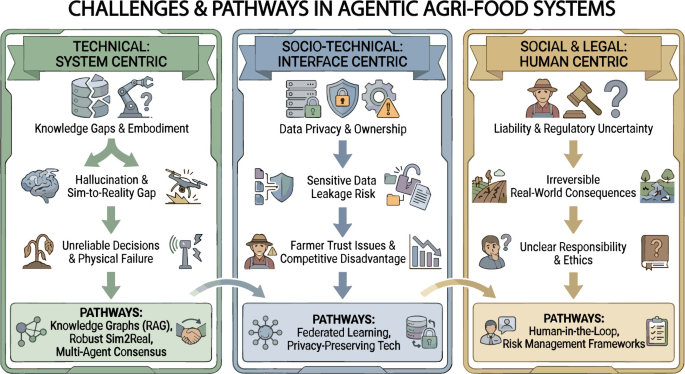
The six challenges discussed above do not operate in isolation but form an interconnected system (Fig. 5). Technical challenges originate from knowledge gaps and embodiment limitations, which manifest as hallucination and sim2real gaps that ultimately lead to unreliable decisions and physical failures. Socio-technical challenges center on the data interface between AI systems and agricultural stakeholders: privacy and ownership concerns create risks of sensitive data leakage, which, in turn, erode farmers’ trust and may confer competitive disadvantages on early adopters. Social and legal challenges stem from regulatory uncertainty about liability, compounded by the irreversible real-world consequences of autonomous agricultural decisions, resulting in unclear attribution of responsibility and unresolved ethical questions. Moreover, these dimensions are mutually reinforcing. Technical failures directly undermine the socio-technical interface by amplifying trust deficits, while unresolved data governance issues feed into broader questions of legal accountability. Addressing these challenges, therefore, requires coordinated pathways: knowledge graphs and robust sim2real transfer for technical reliability, federated learning and privacy-preserving techniques for data governance, and human-in-the-loop protocols with comprehensive risk management frameworks to ensure meaningful accountability.
Potential applications and future research directions
Despite the current socio-technical challenges, agentic AI systems are considered essential to continued improvements in agricultural research and production management. Four key areas are likely to be the front lines, including autonomous scientific discovery, management decision-making, embodiment for agricultural robots, and policy and regulatory (Fig. 6).
Autonomous scientific discovery for phenomics and breeding
Active perception and adaptive phenotyping
Plant breeding is currently being accelerated through high-throughput phenotyping (HTP), yet most platforms remain static data collectors following pre-programmed routes43. Unlike traditional systems, agentic HTP robots utilize active perception to reason about data value in real-time. For instance, in UAV-based sensing systems, upon detecting canopy anomalies, an agent can dynamically adjust its flight path or sensor modality to prioritize high-value genotypes, rather than indiscriminately scanning the entire field44. In controlled environments, robotized facilities have demonstrated that coupling such precise phenotyping with genomic prediction accelerates genetic gain45. Emerging interactive systems like PhenoAssistant31 further bridge the gap between biological expertise and computational complexity, allowing breeders to guide AI agents through natural language.
Decoding the Rhizosphere and G × E interactions
Agentic AI systems can accelerate root phenotyping by optimizing data collection and analysis. While X-ray CT and MRI enable 3D visualization of roots, the data is voluminous and noisy. Agentic systems act as autonomous explorers of this domain, using adaptive segmentation to extract complex traits like branching angles from 3D volumes46,47. Crucially, agents can link these structural phenotypes to genomic data to identify core genetic regions governing root architecture, as demonstrated in foundational studies on the DRO1 gene48,49. By simulating thousands of Genotype × Environment (G × E) scenarios, agents can identify ideotypes optimized for specific soil profiles, linking digital intelligence with biological insight.
Closed-loop discovery
While fully autonomous discovery is nascent in agriculture, the path forward is illuminated by the paradigm of “Self-Driving Laboratories” (SDLs) in adjacent fields. Systems like the Mobile Robotic Chemist50 and the multi-agent Coscientist51 have demonstrated that AI can autonomously formulate hypotheses, parse technical documentation, and execute physical experiments to discover new materials without human intervention. This closed-loop autonomy serves as a blueprint for the next generation of digital breeding. By adapting these agentic architectures, agricultural systems can move beyond passive phenotyping to active discovery, where an agent autonomously selects parents, designs crosses, and interprets phenotypic outcomes to iteratively refine the breeding program. This transformation repositions AI from an analytical tool into a collaborative scientific partner.
Informed decision support for production management
Traditional DSS often rely on isolated crop models52 or static dashboards, but Agentic AI shifts this dynamic from passive data display to active integrated management. This automates the difficult task of interpreting and integrating the data, which the farmer would otherwise perform manually. Agentic AI can specifically address the critical domains of precision irrigation, nutrient optimization, and targeted stress intervention. By fusing distinct data sources, from soil moisture trends to pathogen risk models, agents can optimize these interdependent production variables that are often computationally intractable for human operators.
A major hurdle for general-purpose AI models in this domain is their lack of a specific agricultural context. To bridge this gap, agentic systems integrate three mechanisms that unify historical knowledge with predictive foresight. First, they employ Retrieval-Augmented Generation (RAG) to ground reasoning in established agronomic literature and historical records18. To capture the immediate operational context, they leverage Dynamic Data Integration to ingest live market, weather, and sensor streams. Finally, to project these inputs forward, agents utilize Digital Twins to simulate potential physical outcomes and hypothetical scenarios before execution.
Furthermore, while Reinforcement Learning (RL) is powerful for automated control53, it often struggles in agriculture because feedback such as harvest yield comes only once a season. Agentic frameworks address this by using LLMs as reasoning engines. Instead of learning entirely through trial-and-error, the agent uses its general knowledge to break down long-term seasonal goals into small, manageable tasks, significantly accelerating the optimization process10,23.
Intelligent management of water and nutrients
Actionable irrigation and fertilization depend on accurate state estimation and the ability to anticipate crop demand before stress occurs. While recent global analyses highlight stalling progress in nitrogen use efficiency54, machine learning has demonstrated the capacity to materially improve field-scale soil moisture forecasts relative to conventional baselines55.
However, purely data-driven models often violate physical constraints. A promising path forward is to couple process-based crop models with learned components for hard-to-parameterize processes, such as root uptake and soil hydraulics, within differentiable, constraint-aware hybrids56. These hybrid models provide the robust predictive engine necessary for agentic control. At the management layer, agents can then employ RL to generate variable-rate irrigation and nitrogen plans, explicitly reporting uncertainty and environmental risk. Unlike static rules, these agents learn from outcomes across seasons and diverse farm environments, refining their policies to maximize long-term sustainability rather than just short-term yield57. Together, these advances chart a practical route to water-nutrient management that is predictive, auditable, and locally adaptive.
Targeted intervention for crop stresses
Crop productivity is strongly affected by weeds, pests, diseases, nutrient imbalance, and drought. Agentic AI offers a path toward integrated management of these stresses by closing the loop between sensing, diagnosis, and physical intervention. While advances in optical sensing and deep learning have enabled the early detection of stress at leaf and canopy scales58,59, current workflows remain largely diagnostic, generating static risk maps that leave complex treatment decisions to manual interpretation.
Agentic systems transform this process through active diagnosis and planning. At the sensing layer, agents autonomously prioritize UAV flights or robotic scouting routes toward zones of high uncertainty. By fusing multimodal signals such as RGB, hyperspectral, and thermal imagery, agents can differentiate biotic pathogens from abiotic stressors like drought, quantifying confidence levels in real-time60.
Crucially, the agent then transitions to intervention planning. It evaluates competing remediation strategies, including spot spraying and mechanical weeding, under strict agronomic, regulatory, and economic constraints61. Unlike fixed heuristics, these agents simulate the expected yield protection and environmental impact of each action, providing ranked, auditable recommendations. Over multiple seasons, such systems refine their decision thresholds through reinforcement learning, creating adaptive management strategies tuned to the specific history of the field62.
Embodied agents for harvesting and on-farm logistics
When paired with robotic platforms, agents can potentially be “embodied”, giving them the potential to interact directly with the physical world63, providing additional utility for agricultural robotic systems. Embodied Vision-Language-Action (VLA) models64 can guide robots to perform complex tasks while exhibiting some generalizability to novel tasks. One challenge, however, is that most of the models currently developed are not designed for agricultural contexts. This presents a potential area for future research. Specifically, ag-specific VLAs seem poised to significantly improve the performance on complex tasks such as the robotic harvesting of specialty crops.
Multiple AI agents controlling individual robots could work together as part of a multi-robot system, intelligently collaborating to accomplish tasks. For instance, a fleet of UAVs equipped with sensors could be deployed to scan a field for pest or disease stresses65. Individual agents controlling each UAV could dynamically adjust their mission parameters to focus on areas with the highest disease pressure. This information could then be transmitted to ground robots, which can automatically perform targeted interventions in the affected areas.
Agentic robot platforms offer a path towards practical robotic harvesting by pairing multi-modal sensing with adaptive reasoning. Harvesting remains one of the most demanding operations in the field, where fixed automation often breaks down under heavy occlusion, irregular fruit shapes, shifting canopies, and rapidly changing light. Even state-of-the-art systems show significant performance drops once they leave controlled testing environments66. Instead of executing a predefined sequence, embodied agents can adjust viewpoints, manage uncertainty, and adapt grasp plans as conditions evolve, much closer to how a skilled human picker operates.
Agentic AI-based planning systems could also help optimize the entire harvesting process at a high level. Efficient harvesting depends not just on the actions of a single robot, but also on what happens around the robot, from sequencing tasks to moving produce out of the field. Language-informed planners already support complex navigation and task decomposition in robotics67, and similar approaches could help agricultural fleets divide work between scouting drones, picking robots, and transport units in real time. Recent advances in robotic food handling highlight how coordinated automation can reduce waste and streamline post-harvest workflows68. Extending these ideas, future agentic systems could manage harvesting as an integrated pipeline that plans routes, balances loads, anticipates bottlenecks, and maintains quality. Such systems would bring a new level of resilience and adaptability to on-farm operations.
Regulatory and policies
Policymakers often have a wealth of agriculture-related data available to them, but lack the time and skill set to fully leverage it. These datasets might include remote sensing data, survey results, and stakeholder reports written in natural language. Agentic AI can help ingest large volumes of data and produce actionable insights to guide smarter policymaking.
As an example, Muller et al.9 proposed a system that uses LLMs to parse key information from news reports of injuries in the agricultural sector, such that they can be recorded in a structured, searchable database69. These reports are useful for policymakers trying to determine potential safety hazards. Using LLMs to assist with injury coding may increase the comprehensiveness of this database, thereby facilitating more useful policy interventions. This system could be improved by creating an injury-surveillance agent. Such an agent might be capable of automatically searching for relevant news reports and cross-referencing multiple sources in order to ensure the accuracy of extracted data.
Conclusion
Agentic AI offers a unifying paradigm for agriculture by tightly coupling sensing, reasoning, planning, tool use, and action into closed-loop, goal-driven agents. Addressing both technical and societal risks requires reliability and accountability through interoperable data and metadata, auditable provenance, calibrated uncertainty estimates, and modular tool use, ensuring that decisions remain explainable and transferable across sites, seasons, and stakeholders. In parallel, disciplined deployment relies on shared benchmarks and rigorous field trials, traceable logs for data and model updates, and clearly defined human oversight and escalation policies. With these foundations in place, agentic AI can deliver validated decision support and resilient autonomy, accelerating agricultural innovation while producing measurable gains in productivity, sustainability, and resilience.
Data availability
No datasets were generated or analyzed during the current study.
References
- Wooldridge, M. & Jennings, N. R. Intelligent agents: theory and practice. Knowl. Eng. Rev. 10, 115–152 (1995).Article Google Scholar
- Dennett, D. C. Intentional systems. J. Philos. 68, 87–106 (1971).Article Google Scholar
- Botti, V. Agentic AI and multiagentic: are we reinventing the wheel? https://arxiv.org/abs/2506.01463 (2025).
- Zhao, B., Jin, W., Del Ser, J. & Yang, G. ChatAgri: exploring potentials of ChatGPT on cross-linguistic agricultural text classification. Neurocomputing 557, 126708 (2023).Article Google Scholar
- Yang, X., Gao, J., Xue, W. & Alexandersson, E. PLLaMa: an open-source large language model for plant science. http://arxiv.org/abs/2401.01600 (2024).
- Rezayi, S. et al. AgriBERT: Knowledge-infused agricultural language models for matching food and nutrition. In IJCAI. 5150–5156. https://doi.org/10.24963/ijcai.2022/715 (2022).
- Rezayi, S. et al. Exploring new frontiers in agricultural NLP: Investigating the potential of large language models for food applications. IEEE Transactions on Big Data. 1–12 (IEEE, 2024).
- Xu, D. et al. Large language models for generative information extraction: a survey. Front. Comput. Sci. 18, 186357 (2024).Article Google Scholar
- Muller, J. et al. Large language models for agricultural injury surveillance. Safety, 11, https://doi.org/10.3390/safety11010015 (2025).
- Wu, J. et al. The new agronomists: Language models are experts in crop management. In Proceedings of the IEEE/CVF Conference on Computer Vision and Pattern Recognition (CVPR) Workshops. 5346–5356 (IEEE, 2024).
- Gavai, A. K. & Heringa, J. Agentic artificial intelligence in food science: from automation to adaptation.Food Humanit. 6, 101132 (2026).
- Ussell, S. & Norvig, P. in Artificial Intelligence a Modern Approach. Vol. 25, 79–80 (Prentice-Hall, Englewood Cliffs, 1995).
- Sapkota, R., Roumeliotis, K. I. & Karkee, M. AI agents vs. agentic AI: a conceptual taxonomy, applications and challenges. Inf. Fusion 126, 103599 (2026).Article Google Scholar
- Radford, A. et al. Learning transferable visual models from natural language supervision (eds. Meila, M. & Zhang, T.) In: Proceedings of the 38th International Conference on Machine Learning, Vol. 139 of Proceedings of Machine Learning Research. 8748–8763. 18–24 June (PMLR, 2021).
- Liu, S. et al. Grounding dino: Marrying dino: with grounded pre-training for open-set object detection (eds. Aleš Leonardis, A., Ricci, E., Roth, S., Russakovsky, O., Sattler, T. & Varol, G.) In: Computer Vision–ECCV 2024, 38–55, Cham (Springer Nature Switzerland, 2025).
- Ferguson, I. A. Touring machines: autonomous agents with attitudes. Computer 25, 51–55 (1992).Article Google Scholar
- Müller, J. P. & Pischel, M. The Agent Architecture InteRRaP Concept and Application. DFKI Research Report RR-93-26 (DFKI 1993).
- Lewis, P. et al. Retrieval-augmented generation for knowledge-intensive NLP tasks. (eds. H. Larochelle, H., Ranzato, M., Hadsell, R., Balcan, M. F. & Lin, H.) Advances in Neural Information Processing Systems, Vol. 33, 9459–9474. (Curran Associates, Inc., 2020).
- Pan, J. et al. ChatLeafDisease: a chain-of-thought prompting approach for crop disease classification using large language models. Plant Phenomics 100094, https://doi.org/10.1016/j.plaphe.2025.100094 (2025).
- Wei, J. et al. Chain-of-thought prompting elicits reasoning in large language models (eds. Koyejo, S., Mohamed, S., Agarwal, A., Belgrave, D., Cho, K. & Oh, A.) Advances in Neural Information Processing Systems, Vol. 35, 24824–24837 (Curran Associates, Inc., 2022).
- Hou, X., Zhao, Y., Wang, S. & Wang, H. Model context protocol (MCP): landscape, security threats, and future research directions. Trans. Softw. Eng. Methodol. 35,1–37 (ACM, 2026).
- Yan, B. et al. Beyond self-talk: a communication-centric survey of LLM-based multi-agent systems. http://arxiv.org/abs/2502.14321 (2025).
- Palo, N. D. et al. Towards a unified agent with foundation models. In Workshop on Reincarnating Reinforcement Learning at ICLR 2023 (2023).
- OpenAI. Introducing ChatGPT. https://openai.com/index/chatgpt/, November (2022).
- Zhang, R. et al. PlantGPT: an Arabidopsis-based intelligent agent that answers questions about plant functional genomics. Adv. Sci. e03926. https://doi.org/10.1002/advs.202503926 (2025).
- Koopman, B. et al. Agask: an agent to help answer farmer’s questions from scientific documents. Int. J. Digit. Libr. 25, 569–584 (2024).Article Google Scholar
- Anand, A., Shen, J., Cremers, A. B. & Jacobs, M. Algorithms in the orchard: An embedding-based expert answering system for apple rust. Smart Agri. Technol. 12, 101069 (2025).
- Feng, Y., Wang, Z., Chen, Y. & Zhao, H. LLM agent driven online auction mechanism for agricultural products. Kybernetes 55, 4385-4405 (2026).
- Xu, J. & Fan, C. Assessing household underestimation of hurricane food shortages via large language model agent simulation. Int. J. Disast. Risk Reduct. 128, 105734 (2025).
- Basir, M. S. et al. Meta ag 2.0: A framework for AI-infused contextual agricultural recordkeeping. In 2025 ASABE Annual International Meeting, p. 1. (American Society of Agricultural and Biological Engineers, 2025).
- Chen, F. et al. A conversational multi-agent AI system for automated plant phenotyping. Nat. Commun. 17, 6391 (2026).
- Jin, D. et al. Aleks: AI-powered multi-agent system for autonomous scientific discovery via data-driven approaches in plant science. http://arxiv.org/abs/2508.19383 (2025).
- Khanna, A. et al. Generative AI and blockchain-integrated multi-agent framework for resilient and sustainable fruit cold-chain logistics. Foods 14, 3004 (2025).Article CAS Google Scholar
- Benzinho, J. et al. LLM based chatbot for farm-to-fork blockchain traceability platform. Appl. Sci. 14, 8856 (2024).Article CAS Google Scholar
- Zeng, Y. et al. Insnet-crafty v1. 0: Integrating institutional network dynamics powered by large language models with land use change simulation. EGUsphere 2024, 1–35 (2024).Google Scholar
- Gardeazabal, A. et al. Knowledge management for innovation in agri-food systems: a conceptual framework. Knowl. Manag. Res. Pract. 21, 303–315 (2023).Article Google Scholar
- Ji, Z. et al. Survey of hallucination in natural language generation. ACM Comput. Surv. 55, 1–38 (2023).Article Google Scholar
- Agrawal, G., Kumarage, T., Alghamdi, Z. & Liu, H. Can knowledge graphs reduce hallucinations in LLMs?: a survey. In: Proceedings of the 2024 Conference of the North American Chapter of the Association for Computational Linguistics: Human Language Technologies (Volume 1: Long Papers), 3947–3960, (2024).
- Liu, Y. et al. Aligning cyberspace with physical world: A comprehensive survey on embodied AI. IEEE/ASME Transactions on Mechatronics (IEEE, 2025).
- Anthropic. How We Built Our Multi-agent Research System. https://www.anthropic.com/engineering/multi-agent-research-system (2025).
- Dembani, R. et al. Agricultural data privacy and federated learning: a review of challenges and opportunities. Comput. Electron. Agri. 232, 110048 (2025).Article Google Scholar
- Murugesan, S. The rise of agentic AI: implications, concerns, and the path forward. IEEE Intell. Syst. 40, 8–14 (2025).Article Google Scholar
- Xu, R. & Li, C. A review of high-throughput field phenotyping systems: Focusing on ground robots. Plant Phenomics 2022, 9760269 (2022).Article Google Scholar
- Xie, C. & Yang, C. A review on plant high-throughput phenotyping traits using UAV-based sensors. Comput. Electron. Agri. 178, 105731 (2020).Article Google Scholar
- Bouidghaghen, J. et al. Robotized indoor phenotyping allows genomic prediction of adaptive traits in the field. Nat. Commun. 14, 6603 (2023).Article CAS Google Scholar
- Atkinson, J. A., Pound, M. P., Bennett, M. J. & Wells, D. M. Uncovering the hidden half of plants using new advances in root phenotyping. Curr. Opin. Biotechnol. 55, 1–8 (2019).Article CAS Google Scholar
- Teramoto, S. et al. High-throughput three-dimensional visualization of root system architecture of rice using X-ray computed tomography. Plant Methods 16, 66 (2020).Article Google Scholar
- Uga, Y. et al. Control of root system architecture by deeper rooting 1 increases rice yield under drought conditions. Nat. Genet. 45, 1097–1102 (2013).Article CAS Google Scholar
- Topp, C. N. et al. 3d phenotyping and quantitative trait locus mapping identify core regions of the rice genome controlling root architecture. Proc. Natl. Acad. Sci. USA 110, E1695–E1704 (2013).Article CAS Google Scholar
- Burger, B. et al. A mobile robotic chemist. Nature 583, 237–241 (2020).Article CAS Google Scholar
- Boiko, D. A., MacKnight, R., Kline, B. & Gomes, G. Autonomous chemical research with large language models. Nature 624, 570–578 (2023).Article CAS Google Scholar
- Jones, J. W. et al. The DSSAT cropping system model. Eur. J. Agron. 18, 235–265 (2003).Article Google Scholar
- Mnih, V. et al. Human-level control through deep reinforcement learning. Nature 518, 529–533 (2015).Article CAS Google Scholar
- You, L. et al. Global mean nitrogen recovery efficiency in croplands can be enhanced by optimal nutrient, crop and soil management practices. Nat. Commun. 14, 5747 (2023).Article CAS Google Scholar
- Carranza, C., Nolet, C., Pezij, M. & Ploeg, M. D. Root zone soil moisture estimation with random forest. J. Hydrol. 593, 125840 (2021).Article Google Scholar
- Shen, C. et al. Differentiable modelling to unify machine learning and physical models for geosciences. Nat. Rev. Earth Environ. 4, 552–567 (2023).Article Google Scholar
- Tao, R. et al. Optimizing crop management with reinforcement learning and imitation learning. In Proc. Thirty-Second International Joint Conference on Artificial Intelligence, 6228–6236, (IJCAI,2023).
- Singh, A. K., Ganapathysubramanian, B., Sarkar, S. & Singh, A. Deep learning for plant stress phenotyping: trends and future perspectives. Trends Plant Sci. 23, 883–898 (2018).Article CAS Google Scholar
- Benos, L. et al. Machine learning in agriculture: a comprehensive updated review. Sensors 21, 3758 (2021).Article Google Scholar
- Tzachor, A. et al. Responsible artificial intelligence in agriculture requires systemic understanding of risks and externalities. Nat. Mach. Intell. 4, 104–109 (2022).Article Google Scholar
- Mahlein, A. K. et al. From detection to protection: the role of optical sensors, robots, and artificial intelligence in modern plant disease management. Phytopathology 114, 1733–1741 (2024).Article Google Scholar
- Storm, H. et al. Research priorities to leverage smart digital technologies for sustainable crop production. Eur. J. Agron. 156, 127178 (2024).Article Google Scholar
- Driess, D. et al. Palm-e: an embodied multimodal language model. In Proc. 40th International Conference on Machine Learning, Vol 202, 8469-8488 (PMLR, 2023).
- Kim, M. J. et al. OpenVLA: An open-source vision-language-action model. In Proc. 8th Conference on Robot Learning, Vol. 270, 2679-2713 (PMLR, 2025).
- Sapkota, R., Roumeliotis, K. I. & Karkee, M. UAVs meet agentic AI: a multidomain survey of autonomous aerial intelligence and agentic UAVs. https://arxiv.org/abs/2506.08045 (2025).
- Zhou, H., Wang, X., Au, W., Kang, H. & Chen, C. Intelligent robots for fruit harvesting: recent developments and future challenges. Precis. Agri. 23, 1856–1907 (2022).Article Google Scholar
- Brohan, A. et al. Do as i can, not as i say: Grounding language in robotic affordances. In: Conference on Robot Learning. 287–318. (PMLR, 2023).
- Duong, L. N. K. et al. A review of robotics and autonomous systems in the food industry: From the supply chains perspective. Trends Food Sci. Technol. 106, 355–364 (2020).Article CAS Google Scholar
- Weichelt, B., Salzwedel, M., Heiberger, S. & Lee, B. C. Establishing a publicly available national database of US news articles reporting agriculture-related injuries and fatalities. Am. J. Ind. Med. 61, 667–674 (2018).Article Google Scholar
- Pastor, R., Rodriguez, P. G., Lecuona, A. & Cortés, J. P. Smartagri-region and value engineering. Systems 13, 430 (2025).
Acknowledgements
The authors have no acknowledgments to declare.