
Advertising, Media Consulting, Marketing Research | 09-18-2026
https://www.openpr.com/news/4635288/ai-in-agriculture-market-to-reach-usd-77-0-billion-by-2036-as
AI in Agriculture Market
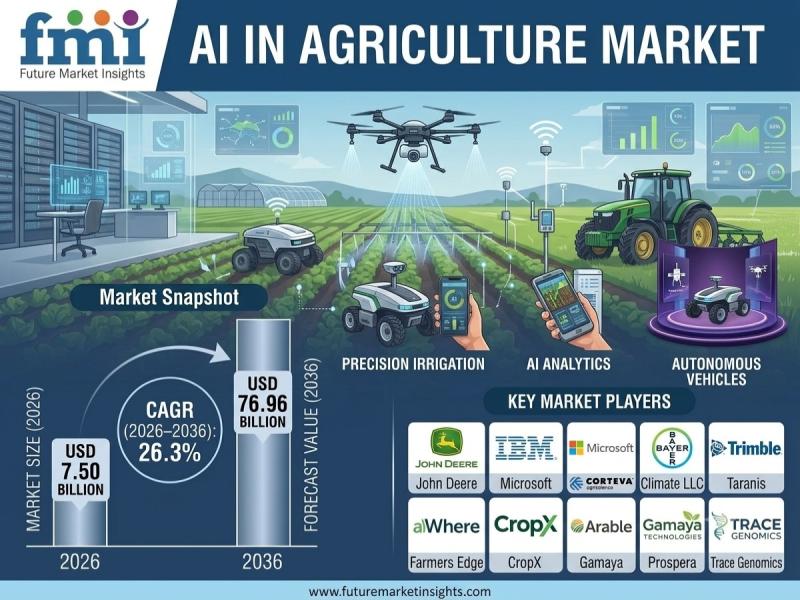
NEWARK, Del., United States – September 18, 2026 – The AI in Agriculture Market is projected to reach USD 77.0 billion by 2036, rising from USD 7.5 billion in 2026 at a 26.3% CAGR from 2026 to 2036, according to Future Market Insights (FMI). The market was valued at USD 5.9 billion in 2025.
The rapid expansion reflects growing pressure to improve agricultural productivity while addressing limited arable land, labor shortages, climate variability, and rising food security requirements. AI technologies are increasingly being integrated with satellite imagery, drones, IoT sensors, precision farming equipment, and farm management platforms to deliver data-driven recommendations across crop production.
Get detailed market forecasts, competitive benchmarking, and pricing trends:
https://www.futuremarketinsights.com/reports/sample/rep-gb-23302
Why Is AI Moving into Mainstream Agriculture?
AI adoption in agriculture is moving beyond pilot programs as farmers increasingly seek measurable improvements in yield consistency and input efficiency. Machine learning, computer vision, and predictive analytics are being deployed for crop monitoring, pest and disease detection, soil analysis, irrigation optimization, and harvest planning.
Labor shortages are also accelerating investment in autonomous equipment and AI-powered monitoring systems. By reducing dependence on manual field inspection and enabling continuous analysis of crop conditions, AI platforms can support more efficient decision-making across large agricultural operations.
Climate variability is another important growth factor. AI-based predictive analytics can help farmers adjust planting schedules, crop selection, irrigation, and resource allocation as weather patterns and growing seasons change.
Key Market Highlights
• 2025 market value: USD 5.9 billion
• 2026 market value: USD 7.5 billion
• 2036 market value: USD 77.0 billion
• 2026-2036 CAGR: 26.3%
• Incremental opportunity, 2026-2036: USD 69.51 billion
• Solution component share in 2026: 69.0%
• Machine learning share in 2026: 47.0%
• Precision farming share in 2026: 34.0%
• UK CAGR, 2026-2036: 25.0%
• USA CAGR, 2026-2036: 22.4%
What Is Driving Growth in the AI in Agriculture Market?
Global food security concerns are creating structural demand for technologies capable of increasing agricultural output from existing farmland. AI-powered precision farming enables data-driven decisions around planting density, fertilizer application, irrigation, and harvest timing.
Agricultural labor shortages across developed and developing economies are strengthening demand for automation. AI-powered crop monitoring, autonomous farming equipment, and computer vision systems can reduce the need for repetitive manual inspection and improve operational efficiency.
At the same time, declining costs of satellite imagery, drone sensors, and IoT field devices are improving the economics of AI-based agriculture. These technologies create extensive data streams that machine learning platforms can process to generate field-level recommendations.
Government agricultural programs are also supporting digital agriculture through research funding, incentives, and technology adoption initiatives, helping expand access to AI tools across different farm sizes.
Solutions and Machine Learning Hold Key Market Positions
The solution component accounts for 69.0% of the component segment in 2026, reflecting demand for integrated AI software platforms that combine satellite, drone, IoT, weather, and field data. Farmers increasingly favor unified platforms that can address crop monitoring, input optimization, and harvest planning through a single interface.
Machine learning represents 47.0% of the technology segment in 2026, supported by its role in crop yield prediction, pest and disease detection, and soil analysis. Deep learning and image-classification techniques are expanding the capabilities of agricultural AI, particularly in applications requiring large-scale field image analysis.
Precision farming represents 34.0% of the application segment, making it the largest individual application category. Variable-rate application and site-specific crop management are important use cases as farmers seek to optimize resource utilization.
UK and USA Show Strong Growth Rates
Regional growth varies across major agricultural markets. The UK is projected to grow at a 25.0% CAGR between 2026 and 2036, supported by agricultural innovation programs, research institutions, and technology-focused farming initiatives.
The USA is expected to record a 22.4% CAGR, with large-scale commercial farming operations integrating AI across crop production. Existing precision agriculture infrastructure, including GPS-guided equipment and variable-rate application systems, provides a foundation for AI integration.
France is projected to grow at 21.6% CAGR, while Germany is expected to register 21.0%. India follows at 20.4%, supported by digital agriculture initiatives, mobile-first advisory services, satellite crop monitoring, and agri-tech innovation. China and Brazil are projected to grow at 19.8% and 19.7%, respectively.
What Challenges Could Slow AI Adoption?
Digital infrastructure gaps in rural regions remain a key constraint, particularly where reliable connectivity limits real-time AI analytics. Farmer adoption can also depend on clear return on investment and interfaces designed around agricultural workflows rather than generic technology platforms.
Data interoperability remains another important development priority. Agricultural equipment manufacturers, input suppliers, farm operators, and AI providers need compatible data systems to enable efficient information exchange.
Despite these challenges, opportunities are emerging in carbon markets, sustainable agriculture certification, autonomous farming, crop intelligence, and AI-enabled advisory services. Platforms capable of measuring and verifying sustainable farming practices could create additional value for both farmers and technology providers.
Analyst Perspective
Future Market Insights analysts note:
“AI in agriculture is transitioning from pilot programs and early-adopter deployments to mainstream commercial adoption.”
The convergence of satellite imagery, drone-based sensing, IoT field sensors, and machine learning analytics is creating precision farming systems designed to deliver measurable yield improvements and input cost reductions. Integrated platforms that combine data collection with actionable recommendations are positioned to address growing farmer demand for practical AI applications.
Competitive Landscape
The AI in agriculture market features agricultural equipment manufacturers adding AI capabilities, dedicated agri-tech software companies, technology firms entering the agricultural vertical, and specialized startups focused on individual agricultural applications.
Key companies include IBM, aWhere, Bayer (Climate LLC), Corteva Agriscience, John Deere, Microsoft, Trimble, Valmont Industries, Taranis, Gamaya, Prospera Technologies, CropX, Arable, Farmers Edge, and Trace Genomics.
Competitive differentiation centers on AI capabilities, agricultural domain expertise, equipment integration, cloud infrastructure, data analytics, autonomous operations, and farmer-centric platform design.
Discover the Full Details in Our Report-Read More Now!
https://www.futuremarketinsights.com/reports/ai-in-agriculture-market
About the Report
The AI in Agriculture Market report covers component, technology, application, and geography across more than 30 countries. The study examines solutions and services by component; machine learning, computer vision, and predictive analytics by technology; and precision farming, drone analytics, livestock monitoring, and supply chain management by application.
The research combines primary interviews with agricultural technology vendors, commercial farm operators, agricultural equipment manufacturers, and government agricultural policy officials with desk research covering agricultural technology publications, government statistics, and agri-tech investment data. Market estimates are developed using bottom-up aggregation across segments and regions and cross-validated against vendor revenues, government programs, and precision farming adoption data.
Explore More Related Reports –
Humanoid Robot Market – https://www.futuremarketinsights.com/reports/humanoid-robot-market
Text Analytics Market – https://www.futuremarketinsights.com/reports/text-analytics-market
Advance Battery Technologies Market – https://www.futuremarketinsights.com/reports/advance-battery-technologies-market
Counter Drone System Market – https://www.futuremarketinsights.com/reports/counter-drone-system-market
Impact-Resistant Composite Radome Structures for High-Bandwidth Antennas Market – https://www.futuremarketinsights.com/reports/impact-resistant-composite-radome-structures-for-high-bandwidth-antennas-market
Contact Us:
Future Market Insights Inc.
Christiana Corporate, 200 Continental Drive,
Suite 401, Newark, Delaware – 19713, USA
T: +1-347-918-3531
For Sales Enquiries: sales@futuremarketinsights.com
About Future Market Insights (FMI)
Future Market Insights, Inc. (FMI) is an ESOMAR-certified, ISO 9001:2015 market research and consulting organization, trusted by Fortune 500 clients and global enterprises. With operations in the U.S., UK, India, and Dubai, FMI provides data-backed insights and strategic intelligence across 30+ industries and 1200 markets worldwide.
This release was published on openPR.