
Jing Huang , August 13, 2026
https://www.aol.com/articles/why-must-empower-young-engineers-090000000.html
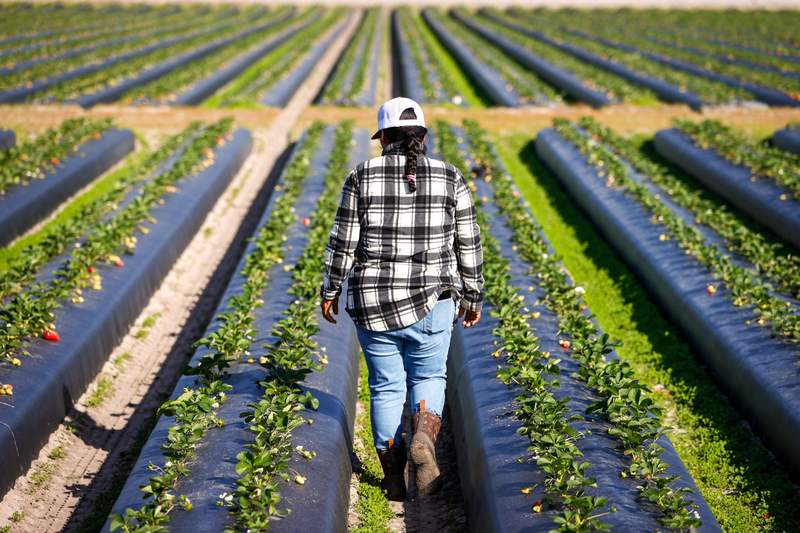
In late July, the U.S. Department of Agriculture launched a national initiative asking researchers and tech leaders to build AI tools for complex agricultural data.

For Florida’s early-career researchers like me, who operate at the intersection of academic engineering labs and global tech powerhouses like NVIDIA, this directive validates a core truth: The next generation of engineers must be at the forefront of moving AI from software servers into physical fields.
Industry benchmarks show that global investments in AI-powered precision agriculture and smart farming will top $3.3 billion this year, with computer vision and machine learning deployment accelerating across more than 70 countries to bolster declining crop yields. It is clear that, as climate volatility, pest outbreaks and acute labor shortages threaten food security worldwide, traditional farming practices are no longer sufficient to feed a growing population.
We need to deploy advanced AI to transform global food production — and empower a new generation of engineers who know how to apply cutting-edge computing to the physical world. Specialized research in agricultural AI is not an isolated discipline, but a vital proving ground where young innovators develop the deep technical versatility needed to solve these complex agricultural challenges.
When most people think of AI, they envision digital chatbots or image generators operating inside clean, controlled computer servers. But the real world, especially an agricultural field, is inherently chaotic. Farms do not feature static lighting, uniform backgrounds or neat geometric shapes. A growing crop shifts in the wind, changes appearance with sunlight and shadows, and develops complex, overlapping biological structures. Developing AI that can reliably navigate these noisy, unpredictable outdoor environments represents one of the toughest computing challenges in science today.
Yet overcoming these challenges is precisely where the future of global food security lies. By teaching AI to move beyond flat, two-dimensional images and master three-dimensional spatial reasoning, researchers can give growers unprecedented visibility into their fields.
Advanced vision-language models — AI systems that can analyze images and answer natural-language questions about what they see — can now combine visual data from multiple camera angles with real-time environmental metrics. These models can detect early disease outbreaks, spot structural defects in farm machinery and precisely evaluate crop health before damage spreads.
Additionally, multimodal time-series modeling — systems that analyze different data streams, like weather metrics and crop images, over time — can help farmers forecast crop yields with remarkable accuracy. Having reliable yield forecasts months in advance changes everything: it empowers agricultural operations to optimize harvesting labor, streamline supply chain logistics, reduce food waste and make data-driven decisions that safeguard our food supply against climate volatility.
Models like PheMuT synthesize computer vision, time-series data and biological plant growth cycles to convert raw field data into actionable forecasts, giving growers concrete tools to manage labor and production planning effectively.
The breakthroughs happening in agricultural AI do not just benefit farmland; they serve as the ultimate proving ground for all physical-world computing. An AI model robust enough to understand a dense, wind-swept strawberry field is uniquely equipped to identify structural defects on an industrial manufacturing line or guide autonomous robotics through hazardous environments. The ability to reason from fundamental principles, understand the core problem and rigorously evaluate solutions in chaotic environments is universally transferable across robotics, physical-world AI and manufacturing.
To meet the compounding demands of changing weather patterns and a growing population, global tech leaders, research institutions and policymakers must invest in young researchers who bridge theoretical computer science with hands-on, real-world application. We need more reciprocal mentorship programs that give early-career engineers the confidence, project leadership skills and interdisciplinary support required to translate complex theoretical models into tangible impact. We cannot afford to let specialized domains like agriculture remain isolated from the broader technology landscape.
By equipping the next generation of engineers with the tools to solve complex physical problems, we can ensure that AI fulfills its highest purpose: protecting, predicting and expanding the essential systems that sustain human life on Earth.
Jing (Zijing) Huang is a Ph.D. candidate in agricultural and biological engineering at the University of Florida Institute of Food and Agricultural Sciences, specializing in computer vision, robotics and physical-world AI systems. He is currently a research intern on the vision-language model team at NVIDIA.