
Chao Kong : 6:23pm, 6 Aug 2026
https://www.scmp.com/news/china/science/article/3363193/chinese-ai-tail-tracking-robot-delivers-needle-free-pig-vaccinations-93-accuracy
In China, robots are being used to inject pigs with vaccines to support intelligent pig farming and meet the production demands of the world’s biggest pork-producing nation.
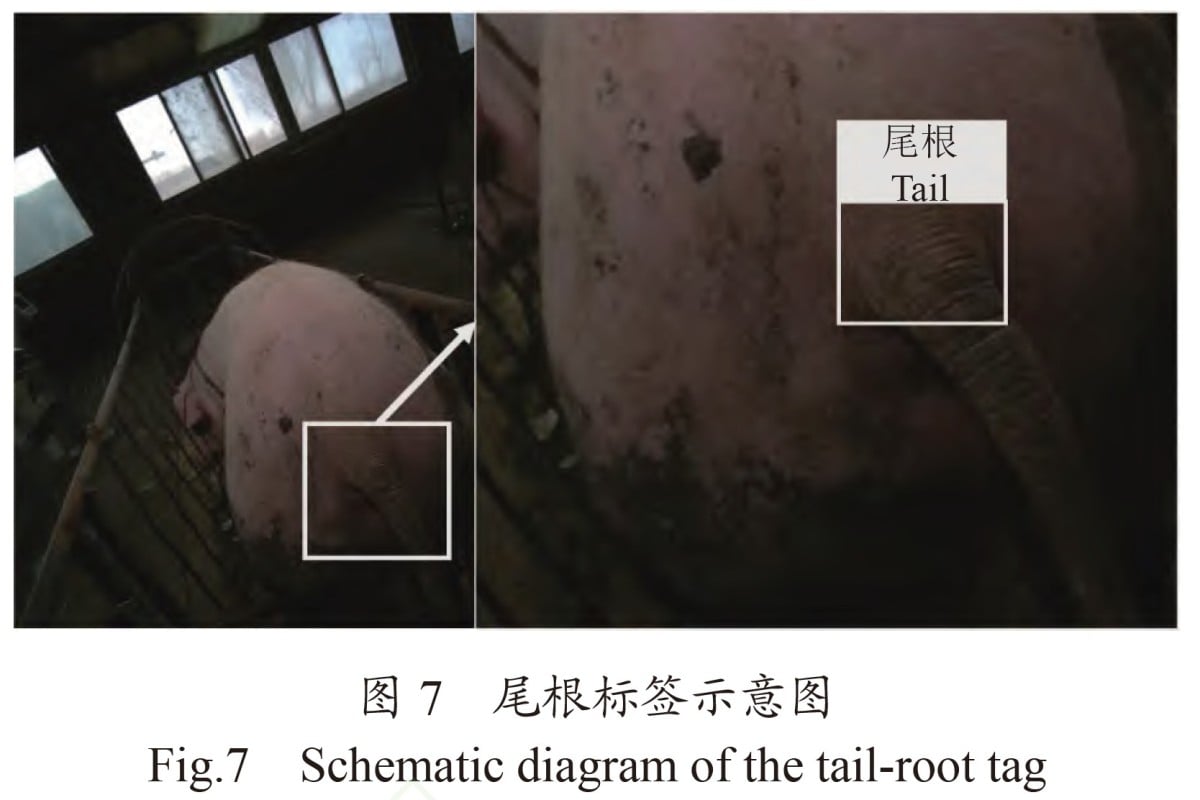
While eating, a pig may not notice the machine approaching from behind before the robot uses a camera to locate the base of the pig’s tail before delivering a needle-free vaccine injection into its buttock.
Vaccination is a routine task, with breeding pigs requiring multiple injections during their production cycles, traditionally making it a labour-intensive aspect of the industry.
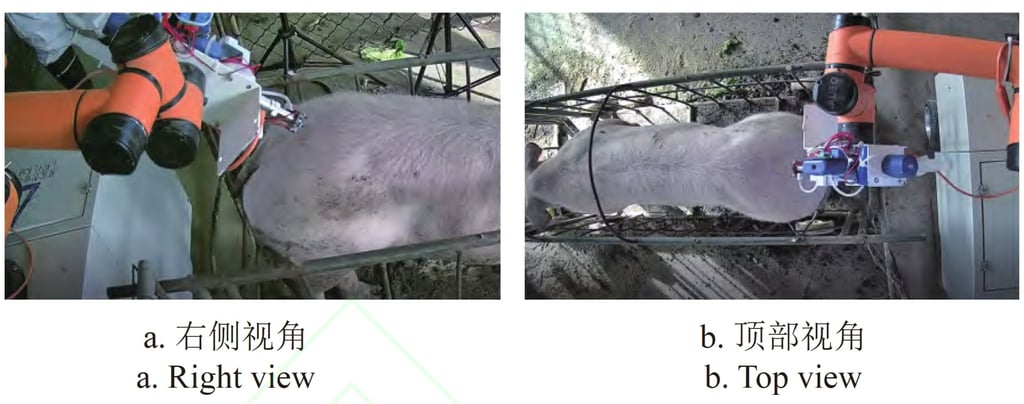
Now, robotics and AI are being combined to create the buttock-tracking robot, which has a success rate of 93.3 per cent, according to Li Bin, a research fellow at the Intelligent Equipment Research Centre of the Beijing Academy of Agriculture and Forestry Sciences.
The robot could support “less-human, automated and intelligent large-scale pig farming”, wrote Li and his team.
The study was published in June in the peer-reviewed journal Transactions of the Chinese Society of Agricultural Engineering.
“Current pig vaccination still relies largely on human workers, creating problems including broken needles, missed injections and inaccurate placement,” Li wrote.
In China, 703 million pigs were slaughtered in 2024, accounting for 54.9 per cent of global production, according to the researchers.
As farms become larger, traditional manual vaccination methods make production demands difficult to meet.
The researchers developed the robot with support from China’s National Key Research and Development Programme for New Generation Artificial Intelligence.
They selected the tail base as the target because it was relatively stable in pigs kept in stalls, while the nearby hip muscle area contained suitable tissue for needle-free injection.
“The accuracy of the injection meets the requirements of pig immunisation operations,” Li and his team wrote in the paper.
Why some Chinese pig farmers are making the switch from white to black
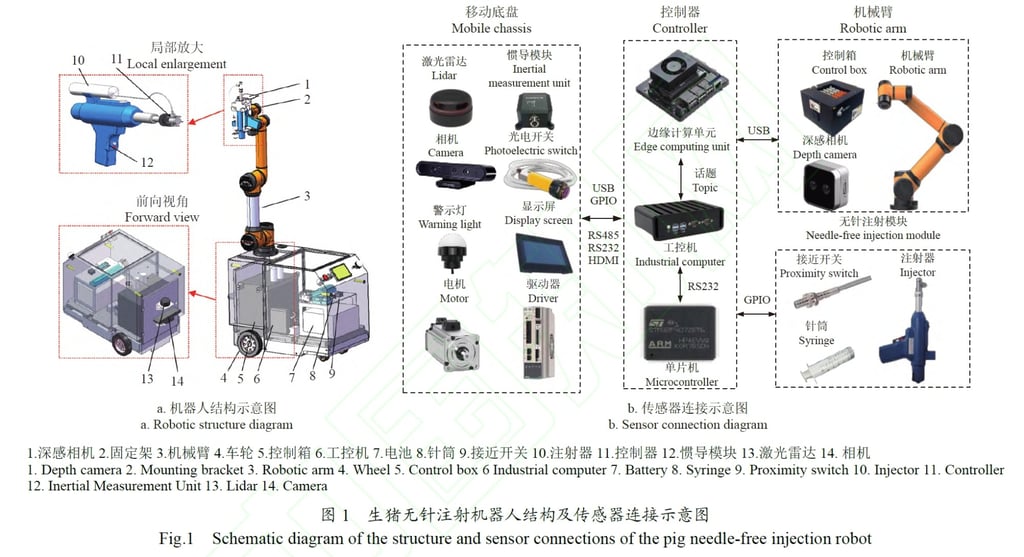
The system combines a mobile platform, a six-axis robotic arm, a depth camera and a needle-free injection module.
The robot uses an AI model to calculate the injection area, correct position and angle for the robotic arm. Before injection, a laser sensor scans the pig holding area and creates a map.
The robot then navigates to a target stall, captures images of the pig’s tail base, calculates the injection point and guides the robotic arm into position.
In field tests at a pig farm in Qinhuangdao, Hebei province, researchers tested the robot on 12 Landrace pigs aged four to five months.
The robot completed 180 injection attempts, with 168 defined as successful. Each injection took about 7.9 seconds, with average positioning errors of around 1cm.
Some failures occurred when pigs moved suddenly, changed posture or moved too close to the stall walls.
Three injection attempts failed when pigs defecated during the procedure, causing their tails to lift and change the detected injection position. A further nine failures were linked to large movements, including pigs lying down during the process.
To reduce movement, researchers synchronised the injection process with feeding, encouraging pigs to remain in a stable position.
Chinese-made humanoid robot tasked with chasing away wild boars in Poland
“Our system demonstrated a complete closed-loop process covering robot navigation, visual recognition, dynamic tracking and precise triggering,” Li and his team wrote.
“Current research on vaccine injection robots for pig farming is mainly focused on product development.”
Future work will focus on improving tail-base detection, tracking algorithms and expanding the model’s application range for real-world deployment.